
The Ghost in the Earth |
Explore the stories and impact of Cuyler Adams and the Cuyuna Range |
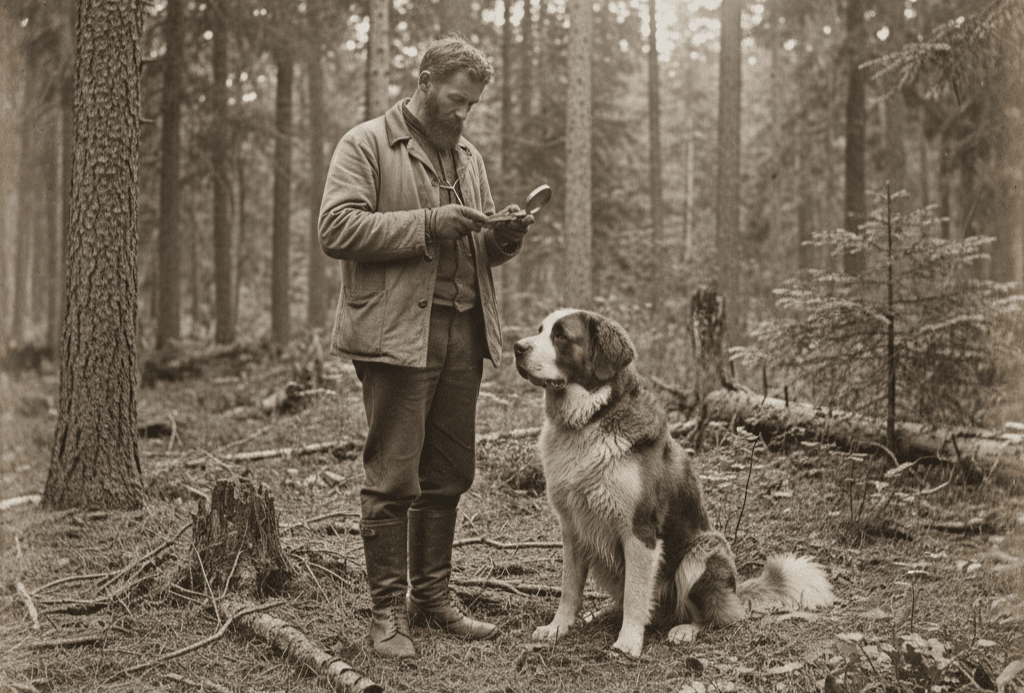
There is a particular kind of courage that history rarely celebrates — not the courage of the battlefield, nor the courage of the statesman — but the quiet, stubborn courage of the man who trusts his instruments over the consensus of his age. In the late nineteenth century, somewhere in the forests between Deerwood and Brainerd, a man named Cuyler Adams watched his compass needle drift — and chose to believe it.
That needle would eventually unlock over 106 million tons of iron ore from beneath your feet — a geologic fortune buried under a hundred feet of glacial till, stretching in a great arc from Brainerd all the way to Aitkin, invisible to every eye but detectable by the patient logic of magnetism. The lakes you fish, the trails you ride, the old pit walls you pass on the way to Crosby — all of it traces back to one spinning needle and one stubborn man. The story of how it came to light is one part frontier adventure, one part scientific method, and entirely a meditation on what separates those who glimpse a pattern from those who act on it for twenty years before they are proven right. |
The Frontier as Classroom |
When Cuyler Adams stepped off a sidewheel steamer into the muddy hamlet of Duluth in 1870, he was eighteen years old, broke, and physically broken — a boy whose lungs couldn't survive the rigors of military academy. The wilderness, his doctors prescribed. The wilderness obeyed. Within months, Adams had partnered with a fur trader, struck north toward Lake Vermilion, and embedded himself among the Bois Fort Ojibwe for an entire year without seeing another white face. He learned the Chippewa language from a Bible. He learned the land from the land itself.
What the frontier gave Adams wasn't merely health — it gave him a literacy in terrain that no classroom could replicate. He learned to read topography the way a banker reads a balance sheet: every depression, every ridge, every magnetic anomaly filed away as potential capital. When he later joined the Northern Pacific Railroad — the same line that had built through Brainerd in 1871 and stitched central Minnesota to the national economy — he exploited that fluency to staggering effect. Spotting a legal loophole in depressed preferred stock certificates, Adams orchestrated a Dakota land deal that netted him roughly $100,000 in profit before he was thirty years old. He wasn't lucky. He was literate in systems others hadn't bothered to read. |
The Noon Shadow That Changed Everything |

By the 1880s, Adams had settled in Deerwood — a timber town he had platted himself on the shores of Reno Lake, just up the road from what is now the beating heart of Crow Wing County. His days were quiet. His surveying work was methodical. And then, one afternoon, his shadow fell across his compass — and the needle didn't follow.
This is the kind of moment that most people dismiss. The mind reaches reflexively for the mundane explanation: faulty instrument, nearby fence post, trick of the light. Adams was different. He already knew — from years spent near the Vermilion Range — that iron ore deposits buried deep underground could distort a magnetic field at the surface. The invisible could announce itself. The ghost in the earth had a voice; you just needed the vocabulary to hear it.
But here is the harder question worth sitting with: What does it cost a man to act on a hypothesis for fifteen years without a single confirming data point? Adams told virtually no one — not his neighbors, barely his wife Virginia. While his peers dismissed the idea of iron at Deerwood as geological fantasy, he disappeared into these same woods every day with a dip needle, an aneroid barometer, a pedometer, and a large St. Bernard named Una. He spent three full years mapping the magnetic contours of an invisible ore body spanning roughly twenty miles of Crow Wing County terrain — building a portrait of something that, according to every expert of his day, simply could not exist.
A Finnish surveyor named Henry Pajari had noticed similar deflections in 1882, drilled briefly, found his shaft flooding with water, and walked away. He later said it plainly: "Adams, not Henry Pajari, should be the discoverer of the Cuyuna Range. I failed in the undertaking." The difference between Pajari and Adams wasn't intelligence. It was interpretive courage — the willingness to see a flooded shaft not as a dead end, but as evidence of something massive lurking just beyond the reach of underfunded drilling. |
The Science of Patience |
Adams spent nearly a year in the New York Astor Library, learning from Swedish geological texts — hiring translators, filling notebooks — before returning to Minnesota to complete his survey. Think about what that requires: to voluntarily immerse yourself in another country's science, in a foreign language, because you believe it holds the key to something beneath your own backyard in central Minnesota. This is not the behavior of a speculator. This is the behavior of a scientist who hasn't yet been granted the credential.
When he finally shared his conclusions with Duluth's mining establishment, they laughed. The geologic consensus was explicit: iron ore simply did not occur in that part of Minnesota. The terrain between Brainerd and Aitkin was wrong. The formation was wrong. Everything was wrong — except Adams's compass. In 1903, with $8,000 scraped together alongside Duluth lawyer W.C. White, drilling finally began near Deerwood. At 100 feet, nothing. At 160 feet, the money was gone. Adams told the crew to keep going. At 164 feet, the water pouring from the drill hole turned black. The ore bed — the Trommald Formation, rich in both iron and manganese — had announced itself at last.
|
The Railroad and the Power of the Map |

Discovery is never the end of the story in industrial America. It is only the beginning of the next fight. When James J. Hill's Northern Pacific Railroad refused to offer competitive freight rates, Adams didn't negotiate. He incorporated his own railway — the Cuyuna Northern — secured competing lake terminals, and connected to the Soo Line to force Hill's monopoly to yield. The first shipment of ore left the Kennedy Mine in 1911, 147,649 tons routed through the very rail corridors that had once defined central Minnesota's commercial fate.
By 1919, nineteen active mines employed over 2,700 miners and shipped more than two million tons of ore annually. Towns like Crosby and Ironton sprang from the ground almost overnight, while well-established communities like Brainerd found themselves sitting atop newly discovered mineral wealth — Brainerd eventually became, remarkably, the only city in the United States that legally owned its own mineral lands. |
Your Backyard, Reframed |
The range that bears his name — Cuyuna, a word that fused "Cuy" from Cuyler and "Una" from the faithful St. Bernard who had walked every foot of that magnetic survey beside him — became a critical supplier of manganese during the First World War, a mineral so essential to wartime steel that entire battles arguably turned on its supply. Today, the flooded mine pits that once terrified early drillers are the same crystal-clear lakes drawing mountain bikers, divers, and paddlers from across the region to Cuyuna Lakes State Recreation Area.
Cuyler Adams died on November 29, 1932, having outlived most of the men who laughed at him. What he left behind was more than a mining district. He left a transformed landscape — one that the Brainerd Lakes area is still living inside of, whether you know it or not. Every time you drive past Crosby, every time you launch a kayak on a lake named after a mine, you are moving through the legacy of a man who trusted a spinning compass needle over the consensus of his age. The ghost in the earth was real. It only needed someone patient enough — and stubborn enough — to keep walking toward it. |
0 Comments
Join the conversation
Be the first to comment
Share your thoughts above.